
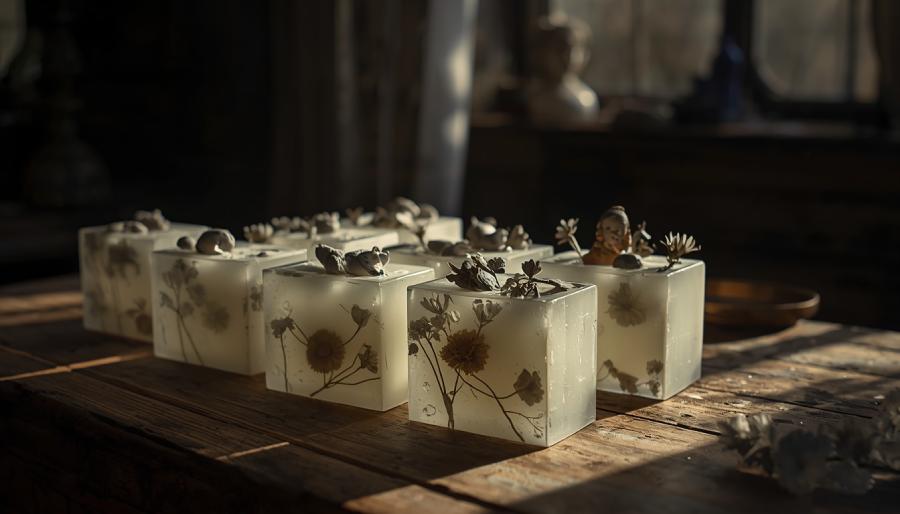
Bri Williams has quietly become one of the most talked-about names in contemporary sculpture, and once you see her work in person, it’s easy to understand why. There’s something almost hypnotic about the way she takes everyday, often forgotten objects and traps them inside soap, wax, and resin, as if she’s preserving a memory before it slips away for good. If you haven’t come across her name yet, you’re about to, because galleries from Paris to Milan to Basel have been showcasing her installations for the better part of a decade, and the buzz around her practice keeps growing.
Who Is Bri Williams?
Bri Williams was born in 1993 in Long Beach, California, and her journey into the art world followed a fairly classic but rigorous path. She earned her BFA from the School of the Art Institute of Chicago in 2015, one of the most respected art schools in the country, and then went on to complete her MFA at Mills College in Oakland in 2017. That Oakland connection stuck, since she still lives and works in the Bay Area today, and it shows in her work. There’s a grounded, almost intimate quality to her pieces that feels rooted in place and personal history rather than abstract theory for its own sake.
What’s interesting about her background is that she didn’t just learn technique in school; she developed an entire visual language built around found and collected objects. Personal heirlooms, old furniture fragments, animal remnants, even taxidermy, all of it gets folded into her sculptures. None of it feels random. Every object seems chosen because it carries some kind of weight, whether that’s a literal family connection or a broader cultural reference.
The Signature Material: Why Soap Matters So Much
If there’s one thing that defines Bri Williams’ work more than anything else, it’s her use of soap as a sculptural material. Most artists reach for bronze, clay, or steel. Williams reaches for something you’d find in your bathroom, and that choice is deliberate, carrying real weight behind it.
Soap, in her hands, becomes a metaphor for two opposing ideas at once. On one side, it represents cleansing, a kind of spiritual or emotional purification. On the other, it acts as a preservation device, encasing objects the way amber traps an insect, freezing a moment in time. She’ll mold soap around things like dried flowers, jewelry, antique dolls, or even bird remains, and over time the soap reacts to humidity in the air, developing a textured, almost sweating surface that changes the piece as it ages. That slow transformation is part of the artwork itself, not a flaw to be fixed. It mirrors how memory works: fading, shifting, never quite holding the same shape twice.
Themes That Run Through Her Work
Williams’ sculptures aren’t just visually striking; they’re conceptually dense. A few themes show up again and again across her body of work, and understanding them makes her pieces hit a lot harder.
Trauma and healing sit at the center of much of what she makes. She’s spoken about using soap allegorically to contain past pain while simultaneously offering a kind of release or cleansing. It’s a tension that never fully resolves, which feels intentional. Real healing rarely wraps up neatly, and her work reflects that honestly.
Identity and power dynamics form another recurring thread. Williams has talked openly about how she initially set out to deconstruct the way she thought about social identity, only to realize that the pressure to frame her work around identity, whether from institutions or internalized expectations, never fully goes away. That self-awareness gives her pieces an added layer of complexity, because she isn’t just making art about identity; she’s making art about the impossibility of escaping that conversation entirely.
Collective memory and family history also surface frequently, sometimes literally. In one notable exhibition, she incorporated recorded audio conversations with her own father, weaving his personal stories, including his experience growing up as a young Black man in a segregated Louisiana town, directly into the sculptural installation. That blending of oral history with physical objects gives her work a documentary quality that’s rare in contemporary sculpture.
Notable Exhibitions Worth Knowing About
Bri Williams has built an impressive exhibition history, and a few shows stand out as turning points or particularly strong representations of her practice.
Her debut solo show, “Lying is the most fun,” opened in 2018 at Interface Gallery in Oakland. It was here that she first showed a headless horse sculpture titled “Medusa,” reframing the mythical figure’s curse as a source of power rather than punishment. That early piece set the tone for how she’d continue working with mythology and reinterpretation throughout her career.
“The Ghost in Me” at Murmurs in Los Angeles followed in 2020, then “Angel Abra” at Kunsthaus Glarus in Switzerland in 2021, a show that helped expand her international reach. That same year, “Out” at Progetto in Lecce, Italy, dove deep into themes of female saints, witches, and ritual exorcism, using objects like raven’s feet and thorny twigs alongside her signature soap and wax.
Her 2021 exhibition “Playbill” at Et al. Gallery in San Francisco is arguably one of her most personal shows to date. It centered around sound works built from conversations with her father, paired with sculptures made from cabinet wood, peeling wallpaper, jewelry, and ceramic figures. Critics described it as feeling like a family album brought to life through sculpture, and it’s often cited as a defining moment in her career.
More recently, she’s shown “Sweet Dreams” at Simian in Copenhagen in 2022, “Mock Serenade” at Dvir Gallery in Paris in 2023, and “An arrow shot over the house that hits no one” at Clima Gallery in Milan in 2025. Each show has pushed her practice in slightly new directions while staying true to the core materials and themes that define her work.
Group Shows and Institutional Recognition
Beyond her solo exhibitions, Williams has been a consistent presence in major group shows across Europe and the United States. She’s appeared at CAPC musée d’art contemporain in Bordeaux, Kunstforum Baloise in Basel, Kunstraum Niederoesterreich in Vienna, and Capitain Petzel in Berlin, among many others. Her recurring presence at Dvir Gallery’s roster, alongside established names like William Kentridge and Douglas Gordon, says a lot about how seriously the gallery world takes her work.
In 2021, she was named to the Short List for the Foundwork Artist Prize, a recognition that put her on the radar of a wider international audience. She’s also been featured in publications like Frieze Magazine, Flash Art, Artillery Magazine, and Art Viewer, with critics consistently praising the emotional and material complexity of her installations.
Why Critics and Collectors Are Paying Attention
There’s a reason Bri Williams keeps getting invited back to major galleries year after year. Her work manages to be both deeply personal and broadly resonant at the same time, which is a hard balance to strike. A piece made from her own father’s stories somehow still speaks to universal experiences of family, race, and survival. That’s not easy to pull off, and it’s part of why critics keep describing her work using words like “uncanny” and “elegiac.”
There’s also the technical side of things. Working with soap as a primary sculptural medium isn’t just a conceptual choice, it’s a genuinely difficult material to control. It shrinks, it sweats, it changes shape over time. Williams has essentially turned an unpredictable, almost fragile substance into a reliable artistic language, which speaks to a real mastery of craft alongside the conceptual depth.
Where to See Her Work
If you’re hoping to catch a Bri Williams piece in person, your best bet is keeping an eye on Dvir Gallery’s exhibition calendar, since they represent her across their Paris, Tel Aviv, and Brussels locations. Clima Gallery in Milan has also hosted her recent solo work, and institutions like Kunsthaus Glarus in Switzerland have featured her in the past. Given how active her exhibition schedule has been over the last few years, there’s a good chance a new show is either currently running or being planned somewhere in Europe or the United States.
FAQs
Who is Bri Williams?
Bri Williams is a contemporary American sculptor born in 1993 in Long Beach, California, known for creating installations using found objects encased in soap, wax, and resin.
What materials does Bri Williams use most often?
She’s best known for using soap as her signature material, often combining it with resin, wax, antique objects, and even taxidermy to explore themes of memory and trauma.
Where did Bri Williams study art?
She earned her BFA from the School of the Art Institute of Chicago in 2015 and her MFA from Mills College in Oakland, California, in 2017.
What themes does Bri Williams explore in her work?
Her sculptures often deal with trauma, healing, identity, power dynamics, and collective or familial memory, frequently drawing on her own personal and family history.
Where can I see Bri Williams’ artwork?
Her work has been shown at galleries including Dvir Gallery in Paris, Clima Gallery in Milan, and Kunsthaus Glarus in Switzerland, with new exhibitions regularly added to her schedule.
Conclusion
Bri Williams has carved out a genuinely unique space in contemporary art, not by chasing trends, but by leaning hard into a material and a set of personal stories that most artists would never think to combine. Her use of soap as both a literal and symbolic medium gives her work a fragility and honesty that’s tough to fake, and her willingness to fold in real family history makes each piece feel like it’s carrying something true. Whether you’re new to her work or you’ve been following her since that first Oakland show back in 2018, it’s clear her career is only building momentum, and it’s worth keeping an eye on wherever she shows next.