
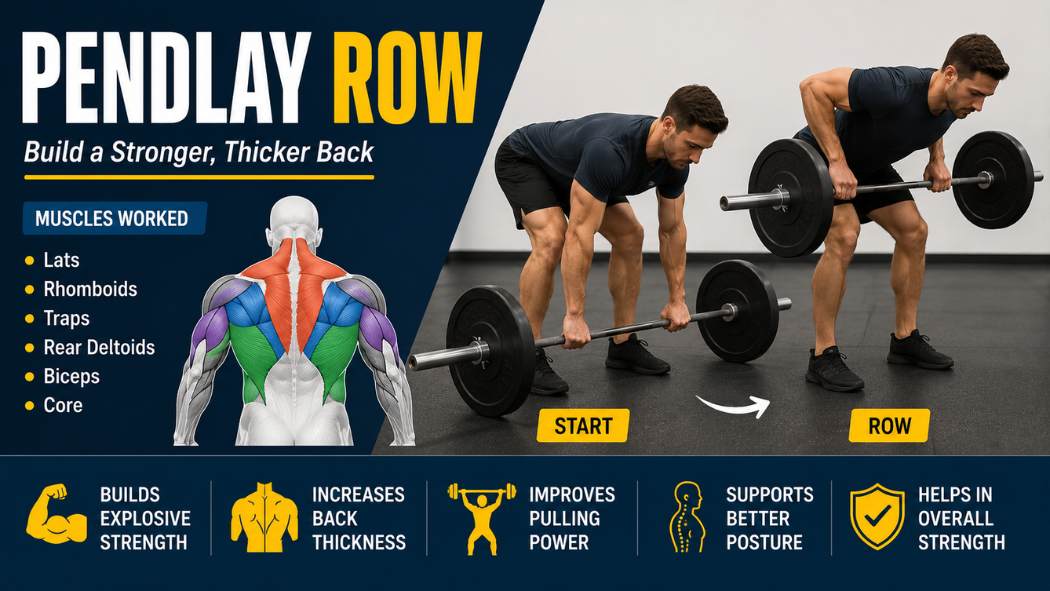
If you want a thicker back, better pulling strength, and improved athletic performance, the Pendlay Row is one of the best exercises you can add to your workout routine. This movement is popular among strength athletes, bodybuilders, and Olympic lifters because it combines power, strict form, and explosive movement in a single exercise.
Unlike many rowing variations, the Pendlay Row forces every repetition to start from the floor. That simple difference changes the entire movement. It removes momentum, increases muscle activation, and helps build real pulling power. Many lifters consider it one of the most effective back exercises ever created.
The exercise was named after Glenn Pendlay, a respected weightlifting coach who became famous for teaching explosive strength training techniques. Today, the Pendlay Row is used worldwide by people who want better posture, more upper-body strength, and a muscular back.
What Is a Pendlay Row?
The Pendlay Row is a barbell rowing exercise performed with the torso nearly parallel to the floor. In every repetition, the barbell begins on the ground and returns to the ground before the next rep starts. This creates a strict and controlled movement pattern.
The main goal of the exercise is to develop explosive upper-back strength. Because the bar rests on the floor between reps, your muscles must generate force from a dead stop every time. This makes the movement more challenging and more effective for strength development.
Many people confuse the Pendlay Row with the traditional bent-over row, but they are not exactly the same. A standard bent-over row usually keeps the bar suspended in the air throughout the set, while the Pendlay Row resets after every repetition. That reset eliminates momentum and increases the demand on the back muscles.
Muscles Worked During the Pendlay Row
One of the biggest reasons this exercise is so popular is the number of muscles it activates. The Pendlay Row targets multiple upper-body muscle groups at the same time, making it an excellent compound exercise.
The primary muscles worked include the latissimus dorsi, rhomboids, trapezius, rear deltoids, and spinal erectors. These muscles help create a thick, powerful, and balanced upper back. The exercise also strengthens the biceps and forearms because they assist during the pulling motion.
Your core muscles are heavily involved as well. Since you must maintain a stable torso position while rowing the weight explosively, your abs and lower back work hard to support the movement. This is one reason why the Pendlay Row can improve overall athletic strength and stability.
Benefits of the Pendlay Row
Builds Explosive Strength
One of the biggest benefits of the Pendlay Row is explosive power development. Every repetition begins from a complete stop on the floor, forcing your muscles to generate maximum force instantly. This helps improve overall pulling strength and athletic performance.
Athletes who participate in sports requiring speed and power often use Pendlay Rows in their training programs. Olympic weightlifters especially benefit from this movement because it mimics the explosive pulling action used in cleans and snatches.
Explosive strength also carries over into other gym exercises. Many lifters notice improvements in their deadlift, pull-ups, and barbell rows after regularly performing Pendlay Rows.
Increases Back Thickness
If your goal is building a thick and muscular back, the Pendlay Row can be extremely effective. The movement heavily targets the upper and middle back muscles, which are responsible for creating depth and density.
Unlike machines that isolate muscles, the Pendlay Row forces multiple muscle groups to work together. This results in more complete upper-body development and a stronger-looking physique.
A well-developed back also improves posture and overall body balance. Many people spend hours sitting at desks or looking down at phones, which weakens the upper back. Pendlay Rows help correct that problem by strengthening the muscles responsible for proper posture.
Improves Lifting Technique
The Pendlay Row teaches proper body positioning and spinal control. Since the movement requires a flat back and stable torso, it helps lifters develop better mechanics for other compound lifts.
Many beginners struggle with maintaining proper posture during deadlifts and rows. Practicing Pendlay Rows can improve awareness of body positioning and reduce bad lifting habits.
Because the exercise emphasizes strict form, it also teaches discipline in training. You cannot rely on swinging or momentum if you want to perform the movement correctly.
How to Perform the Pendlay Row Correctly
To perform the Pendlay Row, start by placing a loaded barbell on the floor. Stand with your feet about shoulder-width apart and grip the bar slightly wider than shoulder width using an overhand grip.
Bend at the hips until your torso is almost parallel to the ground. Keep your spine neutral, chest up, and core tight. Your knees should be slightly bent to maintain balance and stability.
Pull the bar explosively toward your lower chest or upper stomach while keeping your elbows close to your body. Lower the bar back to the floor under control and pause briefly before starting the next repetition. Resetting after every rep is one of the key features of the Pendlay Row.
Common Mistakes to Avoid
Rounding the Back
One of the most common mistakes is rounding the lower back during the exercise. This not only reduces effectiveness but also increases the risk of injury.
Always keep your spine neutral and chest lifted throughout the movement. If you cannot maintain proper posture, the weight is probably too heavy.
Good form should always come before lifting heavier weights. A lighter Pendlay Row with correct technique is far better than a heavy one performed poorly.
Using Too Much Momentum
Some lifters turn the exercise into a sloppy body swing instead of a controlled row. This removes tension from the back muscles and defeats the purpose of the movement.
The Pendlay Row should be explosive but still controlled. The bar should move because of upper-back power, not because you are jerking your entire body upward.
Resetting the bar on the floor between repetitions helps prevent excessive momentum and keeps the movement strict.
Standing Too Upright
Another mistake is allowing the torso to rise too high during the set. The Pendlay Row works best when the torso remains nearly parallel to the floor.
Standing too upright shifts tension away from the upper back and changes the mechanics of the exercise. This turns it into more of a traditional row instead of a true Pendlay Row.
Focus on maintaining the proper body angle from start to finish to maximize muscle activation.
Pendlay Row vs Bent-Over Row
The Pendlay Row and bent-over row are similar exercises, but they have important differences. The Pendlay Row starts from the floor on every repetition, while the bent-over row keeps the bar suspended throughout the set.
The Pendlay Row is generally more explosive and stricter in execution. It focuses heavily on power development and reducing momentum. In contrast, the bent-over row often emphasizes constant tension and controlled movement.
Both exercises are effective, but the best choice depends on your goals. If you want explosive strength and strict pulling mechanics, the Pendlay Row is usually the better option. If your goal is muscle endurance and continuous tension, bent-over rows may be more suitable.
Who Should Do Pendlay Rows?
The Pendlay Row is useful for a wide range of people. Athletes, powerlifters, bodybuilders, and fitness enthusiasts can all benefit from adding it to their routine.
Beginners can use the movement to learn proper pulling mechanics and improve upper-back strength. Intermediate and advanced lifters often use it to break strength plateaus and increase pulling power.
However, people with existing lower-back injuries should be cautious. Since the exercise places stress on the lower back, proper form and appropriate weight selection are extremely important.
Best Rep Ranges for Pendlay Rows
The ideal rep range depends on your training goal. For pure strength development, lower repetitions with heavier weight are usually recommended. Sets of 4 to 6 reps work well for building power.
For muscle growth, moderate repetitions are highly effective. Many lifters use sets of 8 to 12 reps to maximize back hypertrophy and overall muscle development.
Higher repetitions can also improve muscular endurance. Regardless of the rep range, maintaining strict technique should always remain the top priority.
Tips for Better Results
Consistency is one of the biggest factors in improving your Pendlay Row. Performing the movement regularly while gradually increasing weight over time can lead to major strength gains.
Warm up properly before training. Since the exercise heavily involves the lower back and upper body, preparing the muscles and joints beforehand is important for both performance and injury prevention.
Recovery also matters. Eating enough protein, sleeping properly, and allowing muscles to recover between workouts will help you progress faster and avoid overtraining.
FAQs
1. Is the Pendlay Row good for building muscle?
Yes, the Pendlay Row is excellent for building upper-back muscle and increasing overall pulling strength.
2. What is the difference between a Pendlay Row and a bent-over row?
The Pendlay Row resets on the floor after every rep, while the bent-over row keeps the bar elevated throughout the set.
3. Can beginners do Pendlay Rows?
Yes, beginners can perform Pendlay Rows using lighter weights while focusing on proper form and posture.
4. Which muscles does the Pendlay Row target most?
The exercise mainly targets the lats, traps, rhomboids, rear delts, and lower back muscles.
5. How many times per week should I do Pendlay Rows?
Most people benefit from performing Pendlay Rows one to two times per week depending on their training program.
Conclusion
The Pendlay Row is one of the most effective exercises for building a strong, thick, and powerful back. Its strict form, explosive movement, and full-body muscle activation make it a favorite among serious lifters and athletes.
Whether your goal is improving strength, increasing muscle mass, or developing better athletic performance, the Pendlay Row can deliver impressive results when performed correctly. It challenges your body in ways that many traditional rowing exercises cannot.